GuidesWasted spend
Is your prospecting campaign really prospecting? How to check who each ad reaches
A campaign named Prospecting can spend half its budget on people who already know you. How to sort every Meta ad into top, middle or bottom of funnel by who it actually reaches.
On this page
Short answer The campaign's name tells you what you intended. The audience segments breakdown tells you what happened. For each ad, take the share of its spend that reached new people: 70% or more is top of funnel, half or more on engaged people and existing customers is bottom of funnel, and anything between is the middle. An ad in a campaign called Prospecting that lands in the bottom group is retargeting with a prospecting budget. Sort your ads this way once, and you'll usually find a handful of offer ads doing exactly that.
Why names stopped meaning much
With broad targeting and Advantage+ sales campaigns, Meta decides who sees each ad. You set up one campaign for new customers, and inside it each ad finds its own audience:
- An ad that explains the product to someone who's never heard of you tends to reach new people.
- An ad that says "20% off this week" or "Subscribe and save" tends to reach people who already know you, because they're the ones who respond to it.
Both sit in the same campaign, with the same name, and report the same way. The second one usually has the better ROAS, so it gets more budget. That's how a prospecting campaign quietly becomes a retargeting campaign.
How to sort your ads by who they reach
Step 1: Define the segments
In Advertising settings > Audience segments, define your existing customers and your engaged audience (Meta: set up audience segments). Meta then splits results into the new audience, the engaged audience and existing customers (Meta: audience segments reporting). The split starts on the day you save the definitions.
Step 2: Break down at ad level
In Ads Manager, go to the Ads tab for your sales campaigns, pick a closed 30-day range and use Breakdown > By Demographics > Audience segments. For each ad, write down the spend on each of the three segments.
Step 3: Give each ad a stage
| Stage | Rule | The ad's real job |
|---|---|---|
| Top of funnel | 70% or more of its spend reaches new people | Finding new customers |
| Middle of funnel | Between the two | Mixed: warming people up and closing some |
| Bottom of funnel | Half or more of its spend reaches engaged people and existing customers | Closing people who already know you |
The 70% line is a working rule, not a law. Pick your line once and keep it, so months are comparable.
Step 4: Compare the stage with the intent
Now put the stage next to what the ad was meant to do. Three outcomes:
- Meant for new customers, top of funnel: doing its job.
- Meant for retargeting, bottom of funnel: doing its job.
- Meant for new customers, bottom of funnel: this is the one to act on.
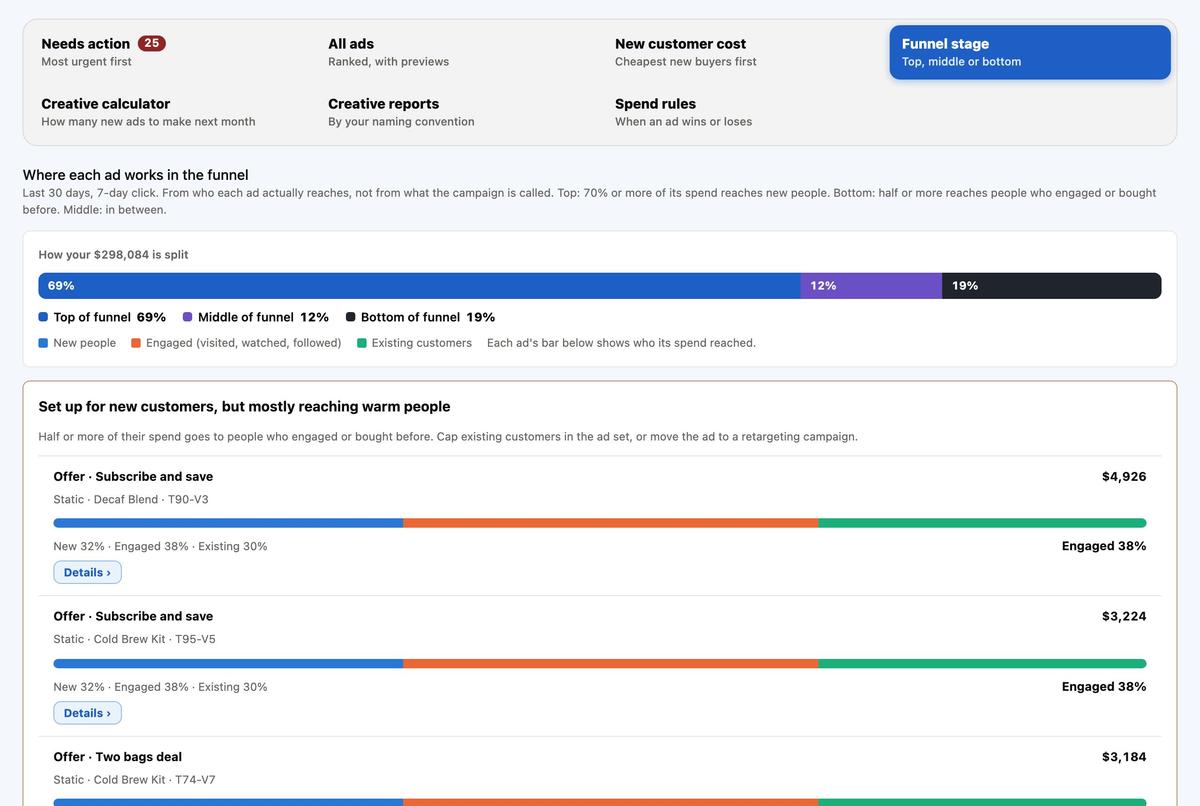
An example of the third kind: an offer ad inside an Advantage+ sales campaign with 32% of its spend on new people, 38% on engaged people and 30% on existing customers. Its ROAS looks strong. Two thirds of its budget goes to people who already knew the store.
Judge each stage on its own number
The same target for every ad is how warm ads win the budget. Use a different yardstick per stage:
- Top and middle of funnel: cost per new customer on 7-day click, against your target. ROAS will look modest. That's expected.
- Bottom of funnel: sales from warm people at a sensible cost, on a small, capped budget. Ask how many of those sales you'd have had anyway.
Then look at the account: what share of spend sits in each stage, and is that the mix you want? If you're trying to grow, most of the budget should be at the top.
What to do with a prospecting ad that reaches warm people
Meta removed the existing customer budget cap, but you still have options (Meta: existing customer budget cap):
- Move the ad to a retargeting ad set with its own small budget, where its job matches its audience.
- Exclude existing customers from the prospecting ad set, or use the Acquire new customers setting (Meta: customer lifecycle strategy).
- Keep it, knowingly. If the ad does bring new customers at your target cost with the part of its spend that reaches them, it can stay. Just stop counting all of it as prospecting.
Whatever you do, watch cost per new customer for the following weeks. More on limits and their side effects in how much of your budget goes to existing customers.
Common mistakes
- Sorting campaigns instead of ads. The campaign average hides the three ads that pull warm traffic.
- Killing every warm ad. Some are your best closers. Give them the right budget and the right yardstick.
- Reading the split before the segments were saved. Earlier spend shows as unknown. Leave it out.
- Judging on default attribution. View-through makes warm ads look even better. Use 7-day click.
How Vibe9 helps
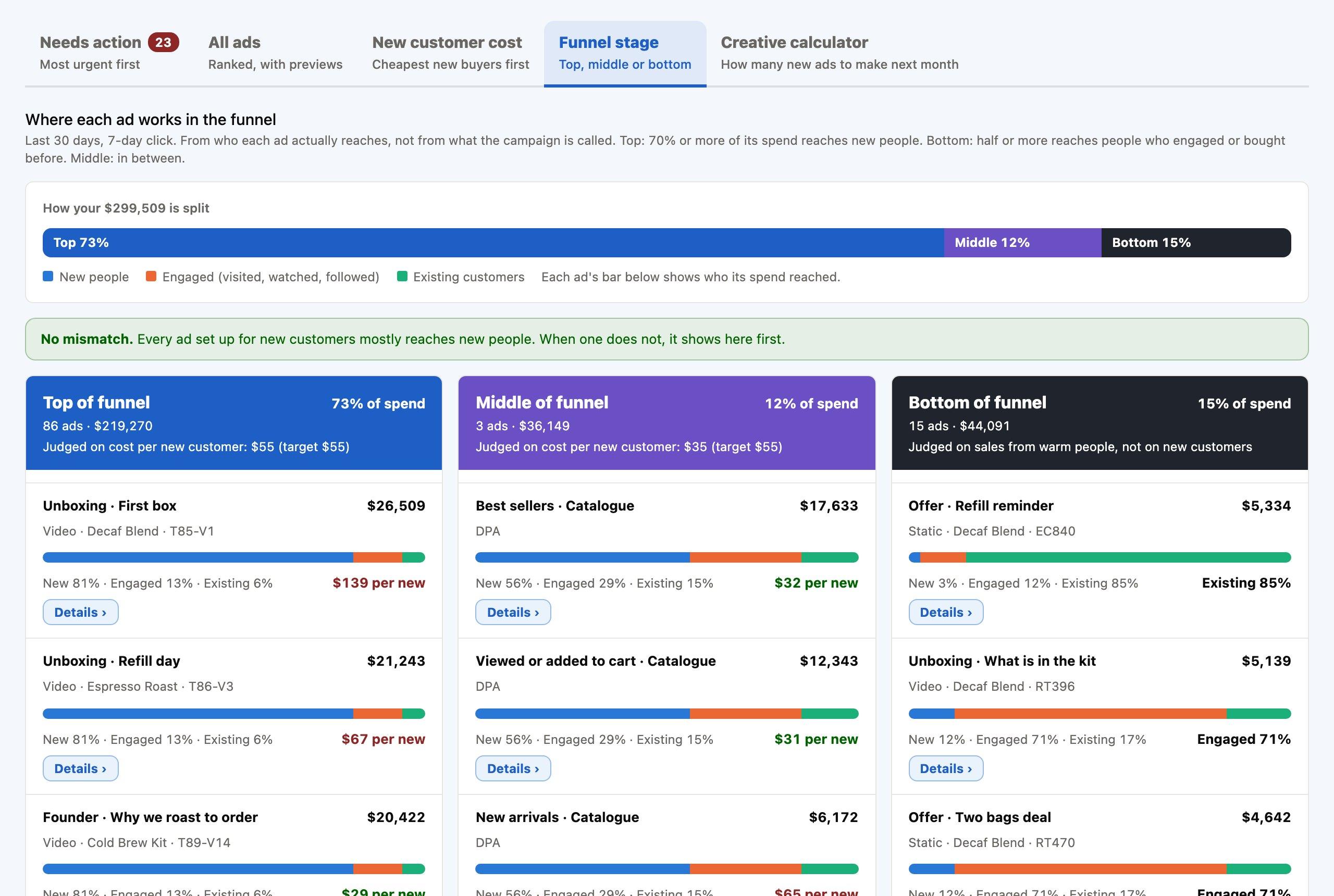
- Funnel stage for every ad: top, middle or bottom, from who the ad actually reaches, not from what the campaign is called.
- Each ad's spend split into new, engaged and existing customers, in one bar.
- A flag for the mismatch: ads set up for new customers that mostly reach warm people, listed first with their spend.
- The right yardstick per stage: top and middle on cost per new customer, bottom on sales from warm people.
- The account's mix: what share of your spend is top, middle and bottom of funnel.
Vibe9 reads your account and never moves or pauses an ad. You decide what to do with the list.
FAQ
How do I know if my prospecting ads reach new people? Break your ads down by audience segments and look at the share of each ad's spend on the new audience. 70% or more is a prospecting ad in practice.
Why does my Advantage+ campaign act like retargeting? Because it optimizes for purchases, and people who know you buy more easily. Offer-led ads in particular drift to warm audiences.
Do I still need a separate retargeting campaign? Not always. Broad campaigns reach warm people by themselves. A small separate one is useful when you want a cap on that spend and a clear place for offer ads.
What's a good top-of-funnel share of spend? It depends on your stage. A brand that wants to grow should have most of its spend at the top. Track your share monthly rather than chasing someone else's number.
Should bottom-of-funnel ads be judged on ROAS? ROAS will always look good there. The better question is incrementality: how many of those sales would have happened without the ad.
See every ad's stage
Sorting 40 ads by hand takes an afternoon and goes out of date in a month. If you'd rather see the funnel stage of every ad every day, request beta access.