GuidesMeasurement
Why did your Meta cost per purchase suddenly go up? A diagnosis in order
Your Facebook ads CPA jumped and nothing obvious changed. Split the change into CPM, click-through rate and conversion rate, then check the seven usual causes in order.
On this page
Short answer Split the change before you touch anything. Cost per purchase is CPM divided by click-through rate and by conversion rate, so one of those three moved. If CPM rose, look at the auction and your budget. If click-through rate fell, look at the ads. If clicks held and conversion rate fell, look at your site, your stock and your offer, not at Meta. Then check the seven usual causes below in order, starting with the ones that cost the most per day. Most "nothing changed" spikes turn out to be one tired top ad, one broken page or one ended promo.
First: is it a real move?
One bad day is usually noise. Before you diagnose, check three things:
- Enough purchases. If the account makes fewer than about 5 purchases a day, single days swing a lot. Compare weeks, not days.
- Closed days. On 7-day click, the last few days are still collecting purchases, so they always look worse than they will. Compare the last 7 closed days with the 7 before.
- The size of the change. A week 10 to 15% off the week before is worth a look. A single day 60% over the last two weeks is worth a look today.
Split the change into three parts
CPA = CPM ÷ 1,000 ÷ (click-through rate × conversion rate)
Take the same two periods (for example last week and the week before) and write down spend, impressions, link clicks and purchases for each. Then compare:
| What moved | What it means | Where to look |
|---|---|---|
| CPM up | You pay more to be seen | Auction season, budget increase, a smaller or more expensive audience |
| Click-through rate down | Fewer people click | Tired ads, a new ad that isn't landing, a change in who the ads reach |
| Conversion rate down (clicks held) | People click and don't buy | Landing page, stock, price or offer, checkout, tracking |
An example. Spend is $70,000 in both weeks. CPM goes from $20 to $21. Click-through rate stays at 1.5%. Conversion rate from click to purchase drops from 3.0% to 2.6%. Cost per purchase goes from $44 to $54, up 21%. About three quarters of that rise comes from the conversion rate and one quarter from CPM. So the first place to look isn't the ads at all.
The seven usual causes, in the order to check them
1. A landing page broke or a product sold out
The sign: click-through rate holds while purchases per click fall sharply, often on a few ads only. Open the landing pages of your top-spending ads. A sold-out product page still loads, so nothing in Ads Manager warns you. This is the most expensive cause per day, which is why it comes first. How to check every page is in Meta ads sending traffic to sold-out or broken pages, and the free landing page checker does ten at a time.
2. A promo ended, or started
Offer ads usually convert cheaper. When a sale ends, the account's cost goes back up, and it looks like a spike only because last week was unusually good. Check whether the share of spend on offer ads changed between the two periods.
3. Your top ad is wearing out
In most accounts a few ads carry most of the spend. When one of them fades, the whole account moves. Look at the five biggest ads of the earlier period: did one's cost per purchase rise by a third or more while it kept its spend? Meta shows its own signal too, for ad sets with a single creative: a Creative limited or Creative fatigue status in the delivery column, based on how often the audience has seen the creative and on its cost per result against your past ads (Meta: creative fatigue recommendations).
4. A winner was paused or lost its spend
If one of your biggest ads lost most of its spend (paused, rejected, or its ad set was edited), the budget moved to weaker ads. The account's cost rises even though no single ad got worse.
5. You changed the budget
Scaling usually raises cost per purchase, because Meta has to reach further for the next buyer. A budget change of a third or more in a week is enough to move it. If you scaled, compare cost at the new spend with your target, not with last week.
6. A significant edit sent ad sets back into learning
Meta says a significant edit makes an ad set re-enter the learning phase, where performance is less stable and cost per result can be higher. Significant edits include any change to targeting, creative or optimization event, adding a new ad to the ad set, changing the bid strategy, and pausing for 7 days or longer. Budget changes count only when they're large (Meta: significant edits and the learning phase). If the spike started the day someone edited the top ad sets, this is your likely cause, and it tends to settle by itself.
7. The mix of who you reach changed
If more spend went to new audiences and less to existing customers, the account's cost per purchase rises, and that can be a good thing: you're buying new customers rather than re-buying old ones. Check cost per new customer on its own before you call it a problem.
What not to do
- Don't edit everything at once. Each significant edit restarts learning, and you'll never know which change helped.
- Don't judge on yesterday. Wait for closed days, unless the cause is a broken page.
- Don't pause the top ad on one bad day. Check its week first.
- Don't look only at the account total. One ad or one page is usually behind it.
- Don't forget your own calendar. Write down promos, site changes and budget moves when they happen. In three weeks you won't remember the date.
How Vibe9 helps
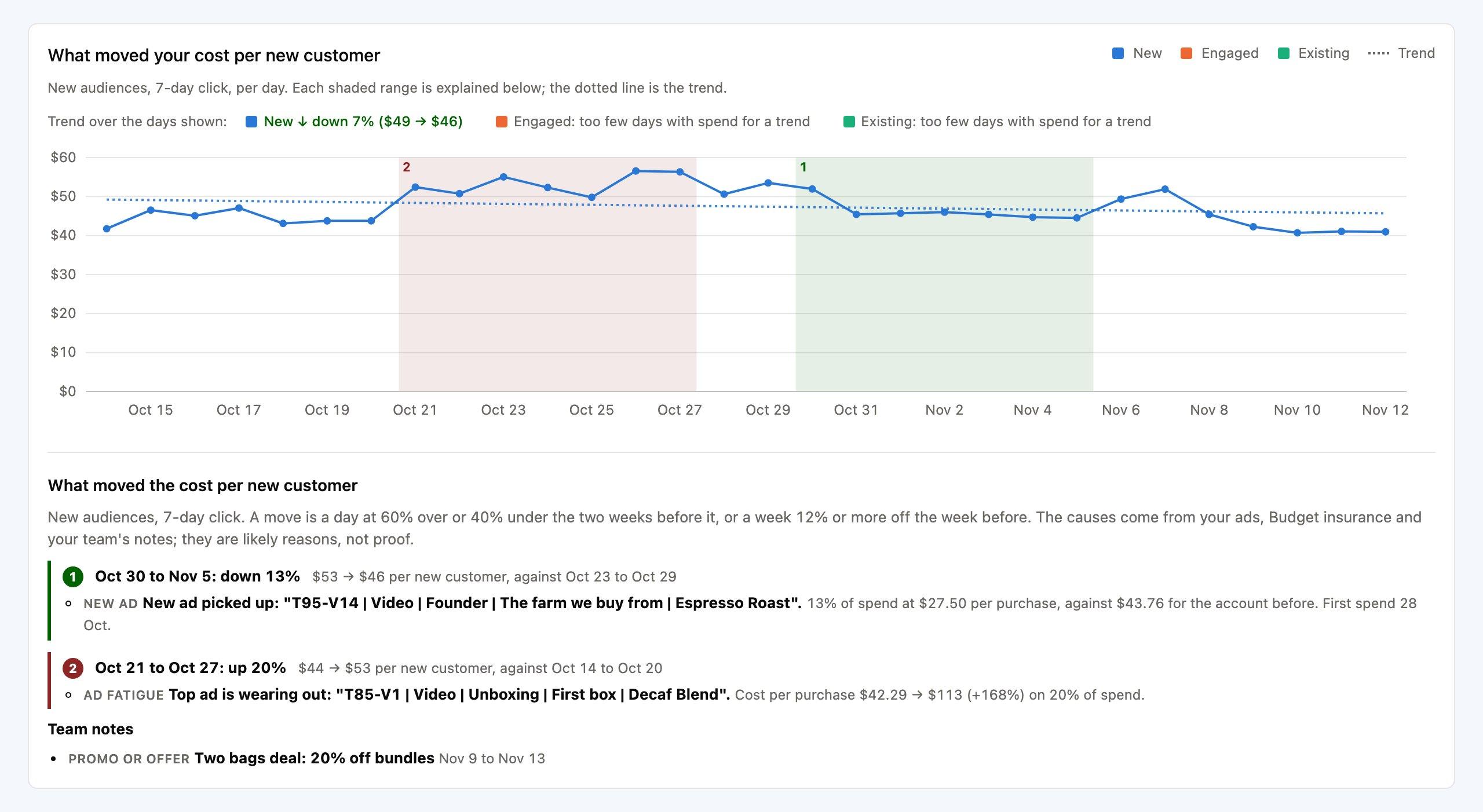
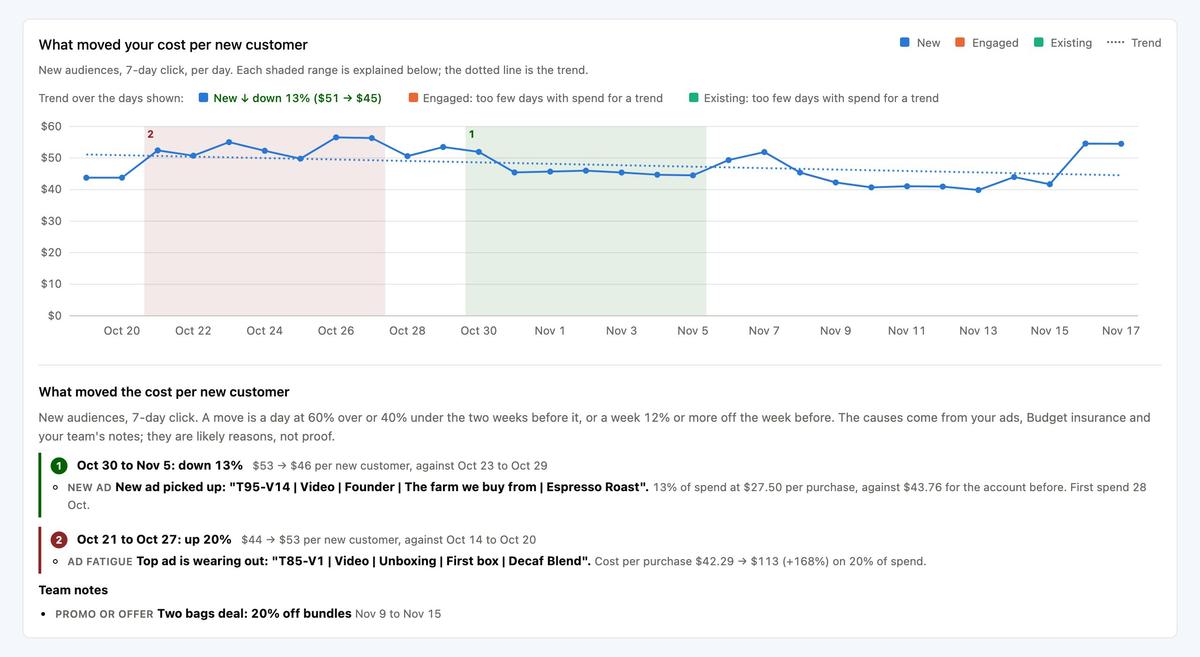
Vibe9's What moved your cost does this diagnosis for you, on cost per new customer:
- It marks the moves: a day far above or below the two weeks before it, or a week 12% or more off the week before.
- For each move it names the likely cause with the numbers behind it: a broken landing page found by budget insurance, clicks that held while purchases per click fell, a promo starting or ending, a top ad wearing out, a paused winner, a strong new ad, or a budget change.
- Team notes put promos, site changes and budget moves on the timeline, so the cause is there when you look back.
- When no cause stands out, it says so: the change is spread across ads.
The causes are likely reasons, not proof. They tell you where to look first.
FAQ
Why did my Facebook ads cost per purchase go up overnight? Usually one of three things: a top ad's landing page stopped working or the product sold out, a promo ended, or a significant edit sent the main ad sets back into learning. Split the change into CPM, click-through rate and conversion rate to see which.
How do I tell creative fatigue from a website problem? Fatigue shows in the ad: click-through rate falls and frequency climbs, on one ad. A website problem shows after the click: click-through rate holds and purchases per click drop, often across several ads that share a page.
How long should I wait before reacting? For a broken page, don't wait. For everything else, compare 7 closed days with the 7 before. Reacting to one day usually means reacting to noise.
Does editing an ad set reset the learning phase? Only a significant edit does: changes to targeting, creative, optimization event or bid strategy, adding a new ad, or a long pause. Small budget changes usually don't.
Is a higher CPA always bad? No. If more of your spend reached new customers, cost per purchase rises while the business gets more of what it needs. Judge the change on cost per new customer against your target.
Find the cause faster
The split above takes ten minutes in a spreadsheet. If you'd rather open your dashboard and see the likely cause next to the move, request beta access.